

Verrucae

Achilles Tendonitis

Post-nail Avulsion

Plantar Fasciitis

Research

content banner


Leg Ulcers

Laser therapy is regularly used in the NHS and private clinics for fast resolution of leg ulcers with improved tensile strength of repair tissue.

Laser can frequently speed up the granulation and epithelialisation phase or, in ulcers that are healing poorly or not at all, activate them. It improves, particularly micro- blood circulation and that of the lymph system, activates anti-oedematous processes, promotes cellular regeneration and inhibits inflammation.


History
Female patient in nursing / residential home with 23 years leg ulceration. Previously treated using Florozene and Alginate dressings.


Treatment
Dose: 8 J/cm2 per treatment (2 minutes per point)
Wavelength(s): Multiple wavelengths
Pulsing: mixed low, medium and high frequencies
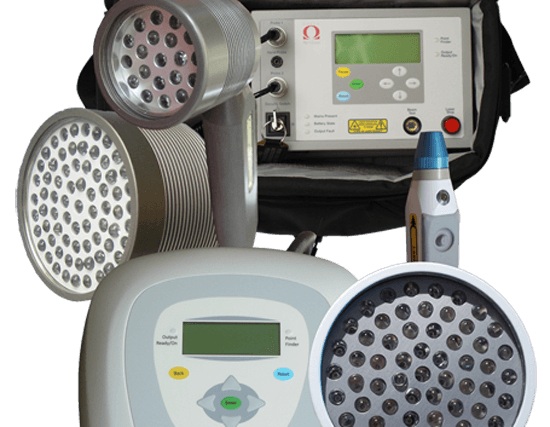
Probe: 46 Diode Cluster Probe
Frequency/intervals: Once every 2 weeks


Outcome
Patient reported being pain-free relatively early on in treatment but complete healing of chronic leg ulceration took a total of 9 months (including a 4 month break due to unrelated illness). Quickly able to socialise, no pain and completely healed.


Clinician
Margaret Knight, District Nurse


leg_ulcer_before leg_ulcer_after

The Use of Low Level Laser Therapy in Diabetic and other Ulcerations. Barbara Robinson MChS, and John Walters, MChS - District Chiropody Service, Preston Health Authority. JBPM /Vol.46 October 1991 No.10 pg 186-189.


The cases illustrated concern the two-month trial period from January to March 1989. The regime was similar in all cases. The ulcers were debrided, and followed by application of laser. The pencil probe (660nm) was used at 2cm intervals around the periphery of the ulcer, and the cluster probe for two minutes over the body of the ulcer, all at a setting of 20Hz. The energy density absorbed is related to the size of the ulcer. Using the pencil probe for every twenty seconds, 2J/cm2 is delivered, and with the cluster probe for each two minutes exposure, approx 5.5J/cm2 is delivered.


Case 1 A forty eight year old man, insulin dependent for twenty six years, and severely neuropathic, with Charcot’s joints. Some progress had been made during 1988 with routine treatment of debridement, Scerisorb Gel and Melolin dressings, with long term antibiotics , but progress had been slow. After introducing low level laser biotherapy into his once weekly treatment there was an immediate effect.


Case 2 An eighty seven year old lady with non insulin dependent diabetes mellitus, with poor peripheral circulation, poor venous return and oedema. There was a long standing ulceration covering lateral, medial, dorsal and posterior aspects of her foot and ankle, with areas of necrotic tissue. Immediately following introduction of laser into her treatment regime a marked increase of serous exudate was noted, so much so that daily saline soaks had to be discontinued and the Kaltostat dressings changed daily. After nine weekly applications of laser therapy, granulation of new tissue was increasing and the texture of the skin appeared normal. She was discharged being completely healed in July 1989.


Case 3 A thirty four year old man, an insulin dependent diabetic with Necrobiosis lipoidica diabeticorum. An injury had resulted in a large ulcer on the anterior aspect of his leg, with a necrotic plaque. This was debrided and laser treatment commenced. Granulation began almost immediately, and three weeks later had reduced the ulcer in size from 5.5cm x 3cm to 5cm x 2.5cm. He was discharged twelve weeks later, his ulcer completely healed.


Case 4 A seventy year old man , insulin dependent diabetic with ishaemic ulcer on the posterolateral aspect of his heel. Both large and small blood vessel disease was present, and he was arthritic, with poor mobility and oedema. After six weeks of treatment there was a reduction in size, from 3cm x 2.5cm to 2.5cm x 1.5cm and a reduction in depth by 4mm.


Case 5 A fifty six year old man, admitted to hospital at the beginning of December 1988 with septicaemia. He was diagnosed diabetic at this time, and was stabilised on insulin before discharging three weeks later. During a routine visit by the diabetic health visitor (A lesion on the anterior aspect of his leg was reported. with a smaller lesion proximally, with tracking between). The areas were debrided laser treatment commenced, and dressings of Scherisorb and Metolin were used. There was an increase in the degree of inflammation after his initial treatment, but granulation was taking place. There was an improvement after each subsequent treatment. He was finally discharged on 8 May 1989, completely healed.


The laser was also used on non diabetic patients.


Case 6 A Forty five year old man, referred to our department. He had been involved in a road traffic accident twelve years previously, leaving him with sensory nerve loss and poor circulation of the lower limbs, particularly the right limb. His right heel had a neuropathic ulcer, which at one stage had been almost healed, but having become infected, resulted in a late non healing ulcer. He had undergone a muscle operation which had slightly improved it, but healing was very slow. Following commencement of laser treatment, progress was slow but consistent, within the eight week period, the lesion was reduced in size by 1.5cm and became shallower.


Case 7 An eighty year old lady, severely crippled with rheumatoid arthritis. She was being treated with steroids, and had poor circulation. On her feet were multiple lesions which were very painful. After a few applications with the laser, the speed of healing was vastly in excess of the most responsive diabetic, with a production of serous exudate and almost immediate pain relief. The healing continued rapidly, and carried on , even after laser therapy had been withdrawn.


Wavelength Power Energy Density Power Density Energy Per Point Pulses
660nm
31 Cluster
660-950nm
15mW

550mW
2/Jcm2

5.5/Jcm2
0.12W/cm2

0.055W/cm2
not given


20KHz


Phototherapy Promotes Healing of Chronic Diabetic Leg Ulcers that Failed to Respond to Other Therapies (2009).  Minatel, D.G., Frade, M.A.C, Franca S.C. and Enwemeka, C. S..  Lasers in Surgery and Medicine 41:433-441.

The Biostimulative Effect of Low Level Laser Therapy of long standing crural Ulcers using helium neon laser, helium neon plus infrared lasers, and noncoherent light: Preliminary report of a randomised double blind comparative study. (1989) I Bihari and A R Mester - Laser Research Laboratory, Postgraduate Medical University, Budapest, Hungary. Laser Therapy by John Wiley & Sons Ltd. ISBN: 0898-5901/89/020097-02.


Multiwavelength Low Reactive Level Laser Therapy (LLLT) as an injunct in malignant ulcers: Case Reports. (1993) M Dalvi Humzah FRCS Dept of Surgery and Radiotherapy, Royal Marsden Hospital, Sutton Surrey. Costas Diamantopoulos Bsc, Dept of Plastic Surgery Queen Mary's Hospital London. Mary Dyson PhD Tissue Repair Unit Dept of Anatomy United Medical and Dental School Guy's and St Thomas' Hospital London. by John Wiley & Sons Ltd. ISBN: 0898-5901/93/040149-04.


The use of Infrared Laser Therapy in the treatment of Venous Ulceration. (1990) M E Sugrue, FRCSI, J Carolan, Bsc E J Leen, MB, T M Feeley, FRCSI, D J Moore, FRCSI, G D Shanik, DFCSI, St James' Hospital Dublin Ireland. Annals of Vascular Surgery: Vol 4, No 2.


Combined Phototherapy/Low Intensity Laser Therapy in the management of Diabetic Ischaemic and Neuropathic Ulcertaion: A Single case series incestigation. (1998) K M Lagan – Rehabilitation Sciences Research Group, University of Ulster at Jordanstown, Northern Ireland. G D Baxter School of Podiatry, University of Central England, Birmingham. R L Ashford, School of Podiatry, University of Central England Birmingham. Laser Therapy by LT Publishers UK Ltd.


Low Level Laser Therapy - Trial by District Nurses. January - March 1997. Frances McNulty Bsc RGN RMN DN CERT - Waterloo Medical Group Northumberland. Issue 12 July 1997 Scottish Nurse pg 42-45.

back to top
